Posts

Imposter Phenomenon

 Imposter phenomenon/syndrome is something that can affect any new employees. It can make you feel unprepared, inadequate, and out of place in a new and competitive environment. The article, "Facing Imposter Syndrome as a New Grad," is very helpful in guiding new grads to assess and confront the characteristics of someone struggling with this issue. I scored less than 30 on the Clance IP Scale meaning I show very few characteristics of Imposter Syndrome. I feel that the questions asked in this assessment were very indicative of the external locus of control that I discussed in my previous blog. I personally relate to a more internal locus of control in that I don't believe I am lucky or successful by chance. I believe that hard work, dedication and passion promote success.  Overall these materials were helpful in identifying negative thought patterns and feelings associated with imposter syndrome. With this knowledge I will be more prepared to confront imposter syndrome h...
Locus of Control

     Locus of control (LoC) is a way of explaining the perception an individual takes on their reality, responsibility and overall challenges in life. LoC can be viewed as internal which would pertain to a person who believes that the things that happen to them are because they made them happen. An example of internal LoC could be when a person accomplishes a goal and accepts that their hard work is what allowed them to do so. LoC can also be viewed as external which would pertain to a person who believes things happen to them because of outside forces. An external LoC might look like someone blaming their own shortcomings or mistakes on others.      While Locus of Control is a continuum, I tend to maintain an internal LoC. This allows me to look at life with a positive, self-directed and self-motivated outlook. LoC is important in occupational therapy because we will experience patients from both sides of the continuum. We need to be prepared to redirect o...

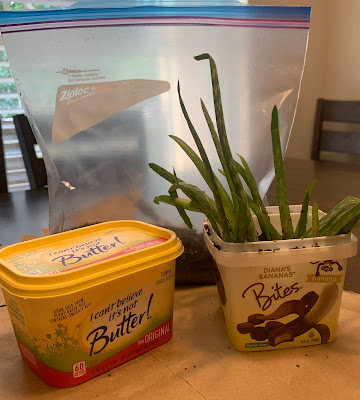
"I can't believe it's in a butter tub!" OT537 Multimedia project

Image
For the multimedia project I was assigned a 51-year old woman with MS and a butter tub. Alice was diagnosed with secondary-progressive multiple sclerosis. She has been experiencing fatigue, numbness/loss of sensation in the hands and forgetfulness. Before the diagnosis Alice enjoyed gardening but hasn't been able to take care of one recently. My goal is to demonstrate and explain the purpose of Alice's OT intervention while using a butter tub to engage Alice in gardening again.  When brainstorming ideas for this project I really had to think about the needs of the client in respect to what I could do with the tub. I decided planting aloe vera would be a simple but meaningful activity for Alice. I consulted with my dad to decide on aloe vera. My ah-ha moment was his approval. Yay! It will work! I like that aloe serves the purpose of burn relief. I would also suggest herbs or something small that could grow on a window sill.  This project definitely allowed me to look at a simpl...

Neuro Note #5 - Dementia/Alzheimer's Disease

Image
Hello! I'd like to introduce you to my grandparents--affectionately known as granny and pa.  Granny and Pa met in May and were married August 10, 1955. From the day they met to the day they were married they were together every day. They loved each other dearly.  Granny and Pa lived a full life together for 62 years. They had two sons, several daughter-in-laws (s/o uncle bob), three grandchildren and a garden full of vegetables and flowers. They enjoyed being outside, going to church and spending time with family.  Granny died of Alzheimer's disease in November 2017. Growing up, I can't remember when the official diagnosis was but I knew she had the signs of dementia. The memory loss was gradual. It was a given that when we would go to see Granny and Pa she would ask the same three questions the entire time we were there. "Where are you in school?", "When will you be done?", "Do you have a boyfriend?" We would always oblige and she would smile ...

Elevator Speech--PDE Goals

 At the beginning of OT school I struggled to explain OT to others. I obviously knew what it meant to me and I had experience in observing it in action. However, I couldn't accurately describe it on the fly. Some of the questions like, "Isn't it like PT?" or "So you help people get jobs?" are certainly frustrating after hearing time and time again. This is why advocacy is still a huge part of my responsibility as a student and future practitioner. Through identifying my personal development goals in Leadership 431 I have been able to put this responsibility to practice. Now, eight months in to OT school I feel very confident explaining my chosen profession. I am excited to talk about OT because I am prepared to explain the joy that is found in encouraging people to find ways to be be independent despite their limitations. Some of the successful conversation elements I use are: inquiring what the person already knows about OT, building off of their previous k...

Neuro Note #4 - Huntington's Disease

"Facing Death Full of Life" a ted talk by Danielle Valenti.  Valenti, D. (2015, December 4). Facing death full of life [Video]. TEDxtalks.  https://www.youtube.com/watch?v=6JRwCdmewl0  For this neuro note I wanted to research Huntington's Disease (HD) because will be learning more about it in class this week. Danielle Valenti addresses her diagnosis and experience watching her mother die from this disease in her Ted Talk "Facing death full of life." Huntington's disease is a degenerative brain disease that affects the basal ganglia area. Nerve cells break down and cause issues with movement, cognition, etc. There is no cure for HD. The disease is highly genetic. If one parent carries the gene the likelyhood of the child acquiring the disease is 50/50. Danielle underwent genetic testing immediately following her mother's death. She wanted to know what her future would look like considering her mother died at age 55.  The diagnosis was very hard on her. Ho...

Neuro Note #3 - Guillain-Barre Syndrome

Andrew's Story: Guillain-Barre Syndrome Franek, A. J. [Andrew J Franek]. (2017, August 1). Andrew's story: Guillain-Barre syndrome [Video]. Youtube.  https://www.youtube.com/watch?v=VWvrHhs2jps  For this neuro note I watched Andrew Franek's documentary of his experience with Guillain-Barre syndrome. I chose this because I had never researched the disorder and I wanted to understand more about it. Andrew's youtube video documents the first signs, symptoms, diagnosis, treatments, therapies, outcomes and emotions that he experienced. He had been sick with a high fever and shortly after (within days) he couldn't walk. The most shocking thing to me about this disorder is how fast it takes over. Andrew couldn't walk within three days. He was paralyzed from this disorder within a month. He was put on a ventilator, had a tracheotomy, an NG-tube, etc. However, he was well into recovery within 5 months!  Guillain-Barre is a rare disorder that can be triggered by infection...

Neuro Note #2 - ALS

Alex Coriell's Journey with ALS Henderson, W. (2018, February 1). Alex Coriell's journey with ALS. ALS News Today.  https://alsnewstoday.com/2018/02/01/alex-coriells-journey-with-als/?utm_source=ALS+News&utm_campaign=856209f0b7-RSS_FRIDAY_EMAIL_CAMPAIGN&utm_medium=email&utm_term=0_0593028b75-856209f0b7-71721017     I watched this short documentary on an inspirational young man who had ALS. Amyotrophic Lateral Sclerosis (ALS) is also known as Lou Gehrig's disease. ALS is a degenerative neurological disease that occurs when nerve cells break down and stop supplying the body with functionality. In Alex's experience he lost control of eating, walking, moving his arms, nose, etc. However he never lost joy. I chose this documentary for my second neuro note because I was curious about ALS and Alex's smile drew me in.  Throughout the process Alex used several different adaptive devices. As an OT student I appreciated seeing this equipment in a home/real-life se...

Neuro Note #1 - Multiple Sclerosis

"How I'm Living My Best Life with Multiple Sclerosis" a ted talk by Robin Brockelsby.  Brockelsby, R. (2020, February). How I'm living my best life with multiple sclerosis [Video]. TED.  https://www.ted.com/talks/robin_brockelsby_how_i_m_living_my_best_life_with_multiple_sclerosis In this TED talk Robin Brockelsby describes her journey with Multiple Sclerosis (MS). I chose to research MS for this neuro note because I was assigned Alice (MS patient) for the multi media project. Also, I have a friend from high school who has battled MS for years and I wanted a better understanding of his diagnosis.  I learned that MS is an autoimmune disease of the central nervous system. Robin explained that the immune system sees the brain, spine and optic nerves as the enemy. Moreover, the immune system attacks the nerves' protective sheath, myelin. Myelin helps propel the nerves signal on to its destination. Once it has become damaged the pathways slow down or are completely bl...

Social Determinants of Health

Social determinants of health are the circumstances in which people are born, live and work in that influence their health status. This includes a person’s socioeconomic status, employment, education, friend/family support, neighborhood, housing, physical environment, and access to healthcare. Social determinants of health are very relevant to health conditions involving the nervous system. Some examples could be carpal tunnel syndrome, traumatic brain injury (TBI), spinal cord injury (SCI), stroke, etc. These conditions may be experienced as a result of a person’s social, behavioral and biobehavioral factors. Social factors could be income, education, culture, family/friend support. Behavioral factors might be diet, tobacco/alcohol use, physical activity, sexual practices, etc. Lastly, biobehavioral factors could be stress, psychological health, allostatic load, etc. For example, a person may have a stroke due to years of unhealthy behavioral choices. As Dr. Rishi Manchanda noted in ...

Adaptive Devices

Comfort and independence are two of the most important reasons for ensuring the appropriate "fitting" for patients using assistive devices. If the assistive devices are not appropriately fitted they can cause pain or discomfort and may do more harm than good. The goal of using assistive devices would be to enhance independence in ADL's. The appropriate fit is necessary to accomplish this goal.  Here are a few examples of how adaptive devices should be fitted for patients to achieve optimal success in ADL's: To fit a patient with a cane the handle should be in line with the wrist crease, ulnar styloid or greater trochanter. Adjustments can be made by releasing the locking mechanism and pushing the button to move the cane to the correct height. The correct height will correspond to 20-30 degrees of elbow flexion.  For axillary crutches the length should be approximately the same length as the distance from the patients forearm to the finger-tips of the opposite h...

Mobility Skills

The order for restoring confidence in mobility skills based on increasing activity demands is a concept that therapists can use to determine where to start with a client who has decreased mobility. The base of the hierarchy is bed mobility, then mat transfers, wheelchair transfers, ADL bed transfer, functional ambulation for ADL, toilet and tub transfer, car transfer, functional ambulation for community mobility, and lastly community mobility and driving. The order of the sequence allows for the completion of one skill to be followed by a more difficult skill. As OT's we want to promote independence. This hierarchy sets the client up to achieve several goals on the road to recovery.  I like this approach because it can be useful for any level of mobility skill. If a client's baseline is ADL bed transfer we assume that bed mobility, mat and wheelchair transfers (if needed) have already been accomplished. I did most of my observation hours in a pediatric outpatient clinic wher...

Posture and Body Mechanics

With 80% of the population suffering from back pain at some point in their lives, it is important that we encourage proper posture and body mechanics through our practice. Faulty posture and body mechanics can lead to back pain which can worsen with unnecessary wear and tear. Explaining proper body mechanics to a client may improve their quality of life! Good body mechanics can prevent or correct problems with posture and protect your body from pain or injury.We can teach proper body mechanics such as bending at the knees rather then the hips when lifting objects from the floor. Another intervention would be to instruct the client on proper posture especially when sitting at a desk. It is easy to "slouch" while typing or writing at a desk. This puts a lot of stress on your cervical vertebrae. In pathology we learned about Wolff's law which states bone will adapt to the load under which it is placed. This explains why we may see a "hunchback" posture in some clie...

Neurobiology: The Influence of Advertisements on the Brain

Education Connection Commercial Jingle circa 2009 https://www.youtube.com/watch?v=WYS5NtRXlZQ   https://www.youtube.com/watch?v=WYS5NtRXlZQ I can confidently say that I know every word to the education connection jingle from their 2009 commercial. The advertisement targets young people considering higher education. Their service helps people “find the right college for free.”   I was 12 years old when the commercial first aired. I can distinctly remember singing the jingle at school with my friends. It was a bop! The jingle in the commercial is easy to remember, catchy and repetitive. These elements allow the brain to make an emotional connection with the tune. When we hear it it has the same effect of listening to a song we know by heart. The part of the brain stimulated by music is the amygdala which is part of the limbic system. This area reacts emotionally to music by eliciting feelings of excitement, happiness, sadness, etc. The ventral tegmental area of the li...

Man from the South

In "Man from the South," we see a young and fearless solider being persuaded into a bet that could leave him little-fingerless. Even though the narrator and his new lady friend discourage him from playing into the bet he believes that he will beat the old man and win his Cadillac. The narrator built up the moment where the solider would either lose his finger or win and then the old man's wife barged in to stop him. She explained how her husband had collected many fingers and lost several cars with this same bet. The solider obviously did not recognize the power of his little finger. Assuming he lost the bet he would be losing about half of the strength of his left hand. Operating a firearm without a little finger would be hard for the solider. He could aim, pull and squeeze with his right hand but he needs the full strength of his left hand to support and stabilize the weapon. He might be able to use a prop to stabilize the weapon but this might not be the case for a...

Dopamine: Neurotransmitter

Image

Implicit Bias

Implicit bias are the subconscious decisions your brain makes upon interacting with others. Our impression of others is formed by the way they look, speak, smell, move, etc. We identify these traits and categorize or stereotype the person we are interacting with. This is a natural process that embeds our preconceived notions about people into our interactions. My big take-away from this session is that we can learn to 'unlearn" our negative preconceived notions. This relates to neuroplasticity which we are learning about in neurobiology. Neuroplasticity is our brains' ability to reorganize by forming new neuronal connections. We do this when we unlearn or reorganize our implicit biases (in a conscious effort). It is very important for OT's to address their own implicit bias. We are in healthcare. We will see a variety of people with a plethora of problems. We can't allow ourselves to make a snap judgement about the client based on their appearance or the problems...

Scapulohumeral Rhythm

The scapulohumeral rhythm allows full ROM and muscle length tension through the motion of shoulder elevation. Shoulder elevation is a synchronous movement between the glenohumeral joint and then scapulothoracic joint.  This means that as the angle of the glenohumeral joint increases during abduction, the scapulothoracic joint moves as well in upward rotation. The scapulohumeral rhythm consists of a 2:1 ratio of glenohuneral joint movement to scapulothoracic movement that produces 180° of full ROM. When we have a client perform abduction/elevation of the upper extremity we observe the rhythm to ensure the total motion. We can observe weakness in the muscles that produce scapular upward rotation such as the trapezius or serratus anterior during the motion. If the scapula does not upwardly rotate, abduction of the humerus will not be complete.  Moreover, dysfunction in one of the joints can decrease ROM or cause impingement/pain.  This may be evident if th...